Gyrafold
Explore the human brain in 3D, right in your browser. Tap a structure to see what it does and what it connects to, then quiz yourself until the names stick.
Free. No account. Works on a phone.
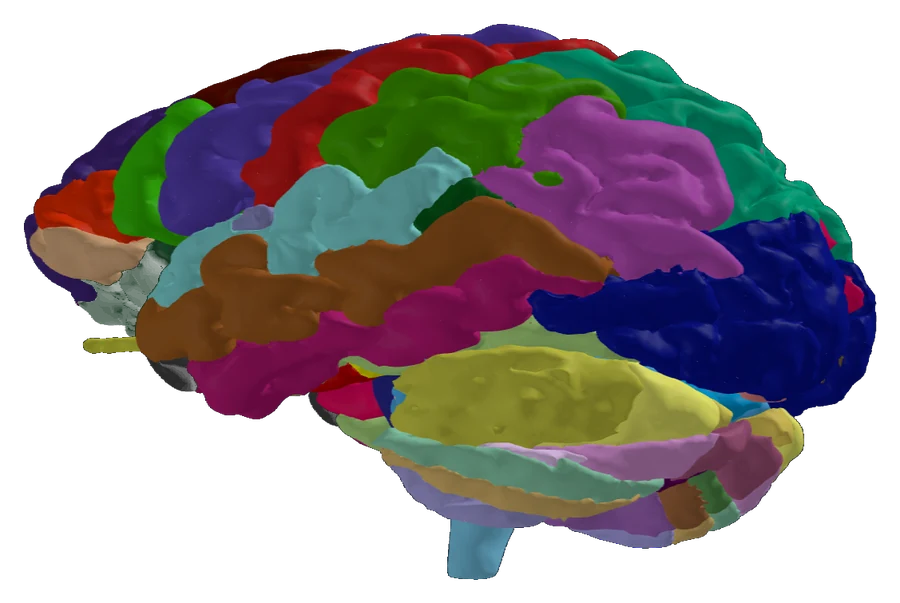
How a brain signals
What you can do
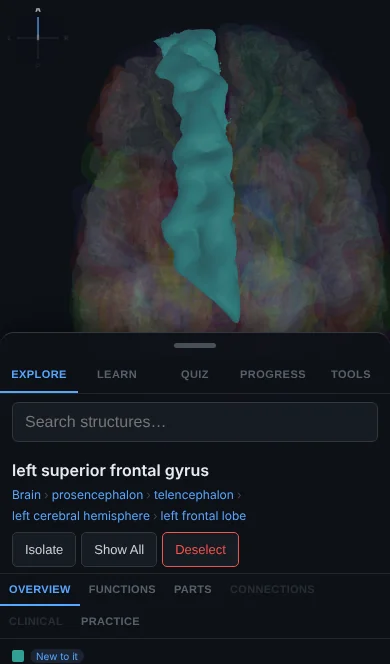
- Explore in 3DRotate, zoom and cut through the brain on three planes. Isolate any region to see it alone.
- Drill into the partsOpen a region such as the thalamus and step into each of its nuclei, with what each one does.
- Learn at your levelBeginner and expert lessons for each structure, with every claim linked to its source.
- Practice that sticksFind-it and name-it quizzes with spaced review bring back what you are about to forget.
- Use it anywhereOn a phone the panel becomes a sheet you drag up; one finger rotates, two fingers zoom.
How it's made
- Real anatomyThe 3D models come from the SPL/NAC Brain Atlas (Halle et al., 2017). A Python and VTK pipeline converts its 359 source files into 328 web-ready models.
- Cited lessonsEvery point in a lesson links to its source, mostly peer-reviewed StatPearls chapters and OpenStax textbooks.
- Learning scienceQuizzes use retrieval practice and a Leitner spaced-review schedule, and they ask how confident you were.
- Private by designNo accounts, cookies or trackers. Your progress stays in your own browser.
- Open sourceBuilt with AI assistance. The source is open on GitHub.
Share it

Scan the code with a phone camera, or share the short link:
giovannicallahan.github.io/brain